Monday, 17 June 2013

Cessna 180


The Cessna 180 is a four- or six-seat, fixed conventional gear general aviation airplane which was produced between 1953 and 1981. Though the design is no longer in production, many of these aircraft are still in use as personal aircraft and in utility roles such as bush flying .

Development
Cessna introduced the heavier and more powerful 180 as a complement to the Cessna 170 . It eventually came to be known as the Skywagon, a name first applied only to the more-powerful 185.

The prototype Cessna 180, N41697, first flew on May 26, 1952. Cessna engineering test pilot William D. Thompson was at the controls.

In all its versions, 6,193 Cessna 180s were manufactured. In 1956 , a tricycle gear version of this design was introduced as the Cessna 182 , which came to bear the name Skylane. Additionally, in 1960 , Cessna introduced a heavier, more powerful sibling to the 180, the conventional gear Cessna 185 . For a time, all three versions of the design were in production.

Design
The airframe of the 180 is all metal, constructed of aluminum alloy. The fuselage is a semi-monocoque structure, with exterior skin sheets riveted to former s and longeron s. The strut-braced wings, likewise, are constructed of exterior skin sheets riveted to spars and ribs . The landing gear of the 180 is in a conventional arrangement, with main gear legs made of spring steel, and a steerable tailwheel mounted on a hollow tapered steel tube.

The Continental O-470-A of was installed in the 1953 model, which uniquely has no baggage door. The Continental O-470-J, also of , replaced the -A model in 1954 and 1955, and was succeeded by the O-470-K from 1956 through 1961, by the O-470-R from 1962 through 1972, by the O-470-S from 1973 through 1976, and by the O-470-U from 1977 through the end of production.

Cessna 180s produced between 1953 and 1963 have two side windows, while 1964 to 1981 models feature three side windows, as they feature the same fuselage as the Cessna 185. Some late production 1962 Cessna 180s were also known to have the three windows as well.

180s can be put on floats if they are equipped with float kits, which are essentially reinforcing members installed at high-stress points of the fuselage.

Operational history
Record flight
The Cessna 180 gained recognition as the aircraft chosen by Geraldine Mock , the first woman pilot to successfully fly around the world. The flight was made in 1964 in her 1953 model, the ''Spirit of Columbus'' (N1538C), as chronicled in her book ''Three-Eight Charlie''. The Cessna factory obtained the aircraft and kept it at the Pawnee (Wichita, Kansas) manufacturing plant after the epic flight, suspended from the ceiling over one of the manufacturing lines. It is currently on display at the National Air and Space Museum .

Variants
180

Four seat high wing light aircraft powered by a Continental O-470-A , O-470-J, or a O-470-K engine, landplane gross weight and first certified on 23 December 1952.

180A

Four seat high wing light aircraft powered by a Continental O-470-K , landplane gross weight and first certified on 17 December 1956.

180B

Four seat high wing light aircraft powered by a Continental O-470-K , landplane gross weight and first certified on 22 August 1958.

180C

Four seat high wing light aircraft powered by a Continental O-470-L or O-470-R, landplane gross weight and first certified on 8 July 1959.

180D

Four seat high wing light aircraft powered by a Continental O-470-L or O-470-R, landplane gross weight and first certified on 14 June 1960.

180E

Four seat high wing light aircraft powered by a Continental O-470-L or O-470-R, landplane gross weight and first certified on 21 September 1961.

180F

Four seat high wing light aircraft powered by a Continental O-470-L or O-470-R, landplane gross weight and first certified on 25 June 1962.

180G

Six seat high wing light aircraft powered by a Continental O-470-L or O-470-R, landplane gross weight and first certified on 19 July 1963.

180H

Six seat high wing light aircraft powered by a Continental O-470-L or O-470-R, landplane gross weight and first certified on 17 June 1964.

180I

There was no "I" model Cessna 180.

180J

Six seat high wing light aircraft powered by a Continental O-470-R or O-470-S, landplane gross weight and first certified on 13 October 1972.

180K

Six seat high wing light aircraft powered by a Continental O-470-U , landplane gross weight and first certified on 19 August 1976.


CESSNA 180:

    Cessna 180 for Sale
    How Much Is a Cessna
    Cessna Sales UK
    Cessna Planes

    Cessna for Sale
    Cessna Jet
    Cessna 185
    1955 Cessna 180 for Sale.


www.AeroSoftCorp.com 

Yunshuji 5 chinese variation of Antonov AN 2


The Antonov AN 2 (Russian nickname: "Annushka" or "Annie") is a single-engine biplane utility/agricultural aircraft designed in the USSR in 1946.
Design and developement:-
The An-2 is used as a light utility transport, parachute drop aircraft, agricultural work and many other tasks suited to this large slow-flying biplane. Its slow flight and good field performance make it suited for short, unimproved fields, and some specialized variants have also been built for cold weather and other extreme environments. The Guinness Book of World Records states that the 45-year production run for the An-2 was for a time the longest ever, for any aircraft, but it was recently exceeded by the Lockheed C-130 Hercules.
The Antonov An-2 was designed to meet a 1947 Soviet Ministry of Forestry requirement for a replacement for the Polikarpov Po-2, which was used in large numbers in both agricultural and utility roles. Antonov designed a large single bay biplane of all-metal construction, with an enclosed cockpit and a cabin with room for seats accommodating twelve passengers. The first prototype, designated SKh-1, and powered by a Shvetsov ASh-21 radial engine, flew on 31 August 1947. The second prototype was fitted with a more powerful Shvetsov ASh-62 engine, which allowed the aircraft's payload to be significantly increased from 1,300 kg (2,870 lb) to 2,140 kg (4,720 lb), and in this form it was ordered into production.
Initial Soviet production was at State Factory 473 in Kiev, Ukrainian SSR where the bulk of up to 5,000 units had been produced by 1960. Later Soviet production (after 1965, of model An-2M especially) was at State Factory 464 at Dolgoprudniy, Russian SFSR. After 1960, however, most An-2s were been built at Poland's WSK factory in Mielec, with over 13,000 made there before full production ended in 1991. Limited production from parts stocks, as well as spares and maintenance coverage continued until 2001, when four aircraft were produced for Vietnam. China also builds the An-2 under license as the Shijiazhuang Y-5. It has been occasionally and erroneously reported that there was East German production of the An-2. While An-2sThe An-2 was designed as a utility aircraft for use in forestry and agriculture. However, the basic airframe is highly adaptable and numerous variants have been developed. These include hopper-equipped versions for crop-dusting, scientific versions for atmospheric sampling, water-bombers for fighting forest-fires, flying ambulances, float-equipped seaplane versions, and lightly armed combat versions for dropping paratroops.The most common version is the An-2T 12-seater passenger aircraft. All versions (other than the An-3) are powered by a 750 kW (1,000 hp) nine-cylinder Shvetsov ASh-62 radial engine, which was developed from the Wright R-1820 It uses 43 gallons of avgas per hour.
 were extensively refurbished in East Germany, there were no new aircraft built there.The An-2 was designed as a utility aircraft for use in forestry and agriculture. However, the basic airframe is highly adaptable and numerous variants have been developed. These include hopper-equipped versions for crop-dusting, scientific versions for atmospheric sampling, water-bombers for fighting forest-fires, flying ambulances, float-equipped seaplane versions, and lightly armed combat versions for dropping paratroops.The most common version is the An-2T 12-seater passenger aircraft. All versions (other than the An-3) are powered by a 750 kW (1,000 hp) nine-cylinder Shvetsov ASh-62 radial engine, which was developed from the Wright R-1820. It uses 43 gallons of avgas per hour.
The An-2 has design features which make it suitable for operation in remote areas with unsurfaced airstrips:
1:-It has a pneumatic brake system (similar to those used on heavy road vehicles) to stop on short runways.
2:-It has an air line fitted to the compressor, so the pressure in the tires and shock absorbers can be adjusted without the need for special equipment.
3:-The batteries are large and easy to remove, so the aircraft does not need a ground power unit to supply power.
4:-There is no need for an external fuel pump to refuel the aircraft, as it has an onboard pump that allows the tanks to be filled from simple fuel drums.
5:-It has a minimum of complex systems. The crucial wing leading edge slats that give the aircraft its slow flight ability are fully automatic, being held closed by the airflow over the wings. Once the airspeed drops below 64 km/h (40 mph), the slats will extend because they are on elastic rubber springs.
6:-Take-off run: 170 m, landing run: 215 m (these numbers will of course vary depending on take-off/landing weight, outside air temperature, surface roughness, and headwind).


A note from the pilot's handbook reads: "If the engine quits in instrument conditions or at night, the pilot should pull the control column full aft and keep the wings level. The leading-edge slats will snap out at about 64 km/h (40 mph) and when the airplane slows to a forward speed of about 40 km/h (25 mph), the airplane will sink at about a parachute descent rate until the aircraft hits the ground." The An-2 indeed has no stall speed quoted in the operating handbook. Pilots of the An-2 say one can fly the aircraft in full control at 30 mph (as a contrast, a modern Cessna four-seater light aircraft has a stall speed of around 50 mph). This slow stall speed makes it possible for the aircraft to fly backwards (if the aircraft is pointed into a headwind of, say, 35 mph (56 km/h), it will travel backwards at 5 mph (8.0 km/h) whilst under full control). (This is also possible with almost any other true Short Take Off and Landing (STOL) aircraft, but the Antonov has the distinction of being able to do the trick in the mildest headwind.)Since the collapse of the Soviet Union and the Eastern European communist states, most airlines in these areas have been withdrawing their An-2s from service, as some of these aircraft are now over 40 years old and the production of avgas had decreased. Private operators are still using the planes, as their stability, capacity and slow-flying ability make them very popular, for instance for skydiving.


yunshuji 7 chinese variation of antonov an-24:-

The People's Republic of China imported the Antonov An-24 from early in its production run and also negotiated licences for production of the aircraft and its engines. In 1966, Xi'an aircraft factory started the project of local production of An-24. The first Chinese-assembled An-24T had its maiden flight on 25 December 1970. Production was launched in 1977 at the Xi'an aircraft factory but progress was slow due to the deleterious effects of the Cultural Revolution, with a pre-production aircraft displayed to the public at Nanyuan air base, near Beijing, on 17 April 1982. WJ-5A1 turboprop engine was chosen as Y-7's power source. The first production aircraft was not flown until February 1984, illustrating the slow progress (eighteen years from licence to production).
The Chinese aircraft equated to the An-24RV, having a full complement of windows and the booster jet engine. The majority of early deliveries were to the Peoples Liberation Army Air Force (PLAAF), mostly as transports, with a few in 52-seat airliner configuration for the Civil Aviation Administration of China (CAAC). After the initial licenced production run the Y-7 was developed separately from the An-24 with a succession of upgrades culminating in the MA60 (Modern Ark) series.
A tactical transport derivative was copied, un-licenced, from the Antonov An-26 and emerged as the Y-7H, incorporating the cargo ramp door and military equipment of the An-26.

Specifications (Y7-100):-
General characteristics

Crew: 1–2
Capacity: 12 passengers
Length: 12.4 m (40 ft 8 in)
Wingspan:

Upper wing: 18.2 m (59 ft 8 in)
Lower wing: 14.2 m (46 ft 9 in)
Height: 4.1 m (13 ft)
Wing area: 71.52 m² (769.8 ft²)
Empty weight: 3,300 kg (7,300 lb)
Loaded weight: 5,500 kg (12,000 lb)
Useful load: 2,140 kg (4,700 lb)
Powerplant: 1 × Shvetsov ASh-62IR 9-cylinder supercharged radial engine, 750 kW (1,000 hp)
Performance
Maximum speed: 258 km/h (139 kn, 160 mph)
Cruise speed: 190 km/h (100 kn, 120 mph)
Stall speed: ~50 km/h (26 knots, 30 mph)
Range: 845 km (456 nmi, 525 mi)
Service ceiling: 4,500 m (14,750 ft)
Rate of climb: 3.5 m/s (700 ft/min)
Power/mass: 0.136 kW/kg (0.083 hp/lb)

As of April 2, 2013 there have been 411 hull-loss accidents of An-2, claiming a total of 391 human lives. One of the most recent accidents occurred around 4:10 in the afternoon on March 23, 2013 in Krasnoyarsk Krai where an Antonov An-2 was dusting crops and crashed into a pond after the engine lost power, killing one of the Pilots.


Sunday, 16 June 2013

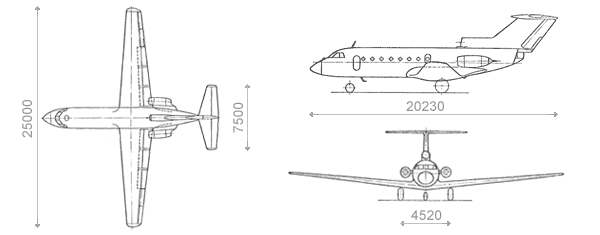
Yakovlev Yak-40

www.AeroSoftCorp.com

The Yakovlev Yak-40 (NATO reporting name: Codling) is a small, three-engined airliner, the world's first regional jet transport aircraft. It was introduced in September 1968 with Aeroflot.By the early 1960s, the Soviet state airline Aeroflot's international and internal trunk routes were flown by jet or turboprop powered airliners but their local services, many of which operated from grass airfields, were operated by obsolete piston engined aircraft such as the Ilyushin Il-12, Il-14 and Lisunov Li-2.Aeroflot wanted to replace these elderly airliners with a turbine-powered aircraft, with the Yakovlev design bureau being assigned to design the new airliner. High speed was not required, but it would have to operate safely and reliably out of poorly equipped airports with short (less than 700 m, (2,300 ft)) unpaved runways in poor weather.
Yakovlev studied both turboprop and jet-powered designs to meet the requirement, including Vertical Take-Off and Landing (VTOL) designs with lift jets in the fuselage or in wing-mounted pods, but eventually they settled on a straight-winged tri-jet carrying 20 to 25 passengers. Engines were to be the new AI-25 turbofan being developed by Ivchenko at Zaporozhye in Ukraine.


The Yak-40 is a low-winged cantilever monoplane with unswept wings, a large T-tail and a retractable tricycle landing gear. The passenger cabin is ahead of the wing, with the short rear fuselage carrying the three turbofan engines, with two engines mounted on short pylons on the side of the fuselage and a third engine buried in the rear fuselage, with air fed from a dorsal air-intake ahead of the fin by a "S-duct", as was an auxiliary power unit which was fitted to allow engine start-up without ground support on primitive airfields. The three AI-25 engines were two-shaft engines rated at 14.7 kN (3,300 lbf). The engines had no jetpipes, and initially no thrust reversers.The pressurized fuselage has a diameter of 2.4 metres (94 in). Pilot and co-pilot sit side-by-side in the aircraft's flight deck, while the passenger cabin has a standard layout seating 24–27 passengers three-abreast, although 32 passengers can be carried by switching to four-abreast seating. Passengers entered and left the aircraft via a
set of ventral airstairs in the rear fuselage.The wing is fitted with large trailing-edge slotted flaps, but had no other high-lift devices, relying on the aircraft's low wing loading to give the required short-field take-off and landing performance. The port and starbord wings join at the aircraft centreline, with the main spar running from wingtip to wingtip, with the wings housing integral fuel tanks with a capacity of 3,800 litres (1,000 US gal; 840 imp gal). The aircraft has a large fin, which is swept back at an angle of 50 degrees to move the tailplane rearwards to compensate for the short rear fuselage. The horizontal tailplane itself is unswept.

The first of five prototypes made its maiden flight on 21 October 1966, with production being launched at the Saratov Aviation Plant in 1967 and Soviet type certification granted in 1968.The type carried out its first passenger service for Aeroflot on 30 September 1968.In the 1972 version, a tailspin was removed. In 1974, new version was introduced, with non-stop flight distance increased. Also, the forward door on the right side of the fuselage change its place – it was located together with the sixth window.In 1975, the last upgrading of Yak-40 took place – the number of cabin windows on the right side changed from nine to eight.By the time production ended in November 1981, the factory at Saratov had produced 1,011 aircraft. By 1993 Yak-40s operated by Aeroflot had carried 354 million passengers.As well as being the backbone of Aeroflot's local operations, flying to 276 domestic destinations in 1980, the Yak-40 was also an export success. More than this, Yak-40 became the first Russian/Soviet 
aircraft getting flying certificates of Italy and West Germany. It was demonstrated in 75 countries of the world, including the USA, where orders on Yak-40 were made.


YAK-40 MODIFICATIONS & PROJECTED VARIANTS:-->

The Yak-40's most noticeable design feature is its trijet configuration, with three specially developed Ivchenko AI-25 two shaft turbofans. The three jet engine layout was chosen for increased redundancy (and hence better one engine out performance, allowing good short field performance). The unswept, high aspect ratio wing is also designed for good field performance. An APU and a ventral airstair in the rear fuselage allow autonomous operation at remote airfields. A high power-to-weight ratio allows the Yak-40 a good hot-and-high performance - operating economics was a lesser priority.
The Yak-40 remained basically unchanged during its production life, but a number of developments were proposed, including the Yak-40M, a 40 seat stretched development. For a time a US company, ICX Aviation, planned to build the type in the USA with western avionics and three Garrett TFE731 turbofans. The Yak-40TL twin engine conversion was also proposed. The main difference would have been the replacement of the Yak-40's three engines with two Lycoming LF 507s.
The Yak-40K is a cargo-passenger version with a port-side forward cargo door with a maximum payload of 3200kg (7055lb) in all freight configuration.
The Yak-40D has two additional fuel tanks to increase the total fuel capacity to 6000kg (13,200lb). The Yak-40DTS is a troop carrier and paramedic configuration. Other versions are equipped for calibration, meteorological research, testing and inspecting of radio-electronic equipment, and for use as an engine testbed.
Apart from airliner use, a number are in service as corporate or government transports with a VIP interior.
* With so many Yak-40s built and the type proving successful, it's not surprising that upgrade efforts have been performed to keep it in service. The upgrades have featured airframe refurbishment, update of avionics for international service, and very often conversion to VIP configurations. Even Yak-40Ks have been updated to VIP configurations, it appears with the cargo door sealed shut. There have also been a few "long-range" updates, designated "Yak-40D/40KD", where "D" stands for "dalniy (range)", involving addition of more fuel tanks in the wings for an effective doubling of range.

There were several special-mission conversions of Yak-40s:

*Navigation aids calibration aircraft, externally similar to a "stock" Yak-40 except for a few added antennas, with such machines used by several Eastern European nations.

*A number of one-off weather research platforms with names like "Akva (Aqua)", "Liros", "Shtorm", and "Meteo" -- the last being a fairly common name for a Soviet weather research aircraft. Details are not all that clear, though a photo of the Yak-40 Meteo shows a heavily modified machine with a ventral equipment pod, observation windows, and a nose probe.

*Four conversions by the Polish Air Force as tow-target tugs, with the winch and other gear installed in the rear door; the forward service door had to be used to get in and out.

*Several engine and avionics testbeds, for example one aircraft flown by the Lavochkin OKB for test of air and space vehicle subsystems.

*A single prototype of a "Yak-40DTS" military transport with paradrop and medical evacuation ("medevac") capabilities was built, it seems as a modification of a stock Yak-40. It did not go into production.


Specifications:
General characteristics:-->

Engine:            АИ-25

Crew:               3 two pilots ,flight engineer

Capacity:           32 passengers

Length:             20.36 m (66 ft 9½ in)

Wingspan:           25.00 m (82 ft 0¼ in)

Height:             6.50 m (21 ft 4 in)

Wing area:          70.00 m² (753.5 ft²)

Empty weight:       9,400 kg (20,725 lb)

Max. takeoff weight: 15,500 kg (34,170 lb)

Thrust:             3 х 1 500 kg

Powerplant:
3 × Ivchenko AI-25 turbofans, 14.7 kN (3,300 lbf) each

Performance:-->

Maximum speed:       550 km/h (297 knots, 342 mph) at 7,000 m (23,000 ft) (max cruise)

Range:               1,800 km (971 nmi, 1,118 mi)

Height of flight:    8 000 m

Cruise speed:     550 km/h

Service ceiling:      8,000 m 

Rate of climb:        8.0 m/s (1,575 ft/min)


Production:  

Total Yak-40 production is 1011, of which approximately 750 were built for Aeroflot. Approximately 490 remained in airline service in late 2000, others are used as corporate transports.


Notable accidents and incidents:

On May 4, 1972, an Aeroflot/East Siberia Yak-40 with 18 passengers and crew on approach to Bratsk Airport, Russian SFSR crashed due to wind shear. All aboard perished.

On February 28, 1973, an Aeroflot/Kazakhstan flight from Semipalatinsk Airport, Kazakh SSR to Ust-Kamenogorsk Airport, Kazakh SSR fell back onto the runway after take-off. All 28 passengers and 4 crew died.

On July 15, 1975, an Aeroflot/Armenia passenger flight from Zvartnots International Airport, Armenian SSR to Batumi-Chorokh Airport, Georgian SSR on go-around crashed into Mount Mtirala in the Caucasus Mountains killing all 41 on board.

On August 15, 1975, an Aeroflot/Azerbaijan aircraft from Baku Airport, Azerbaijan SSR to Krasnovodsk Airport (now the airport of Türkmenbaşy), Turkmenistan) stalled and subsequently crashed during approach due to pilot error and unfavourable weather conditions, killing 23 of the 28 on board.

On September 9, 1976, an Aeroflot/North Kavkaz flight from Rostov Airport, Russian SFSR to Kerch Airport, Ukrainian SSR collided with an Antonov An-24 over the Black Sea 37 km (23 mi) off Anapa due to violation of separation rules, the error of both aircraft crews and probably ground ATC. All 18 occupants of the Yak-40 and 46 people on board the An-24 died.

On October 7, 1978, an Aeroflot/Kazakhstan flight with 38 people on board departed Sverdlovsk-Koltsovo Airport, Russian SFSR for Kostanay-Narimanovka Airport, Kazakh SSR but the left engine failed about 30 seconds after take off, due to icing. The aircraft lost height and collided with a hill killing all occupants.

On June 8, 1980, a TAAG Angola Airlines Yak transporting civilians was shot down by a MiG-19 (origin unclear) near Matala, Angola killing all 19 occupants.

On June 12, 1980, an Aeroflot/Tajikistan on a passenger flight from Leninabad, Tajik SSR (Khujand, Tajikistan since 1991) to Dushanbe Airport, Tajik SSR with 29 on board crashed into a mountain 44 km (27 mi) north-west of the airport due to navigational errors by the crew, killing all occupants.

On September 18, 1981, an Aeroflot/East Siberia flight from Irkutsk Airport, Russian SFSR to Zheleznogorsk-Ilimskiy Airport, Russian SFSR collided with a Mi-8 helicopter on a training flight while approaching its destination airport. The supposed site of the collision occurred in the clouds. All 33 on board the Yak-40 and seven occupants of the Mi-8 were killed, making it the deadliest Yak-40 incident at the time.

On January 16, 1987, an Aeroflot aircraft operating Flight 505 crashed after takeoff in Tashkent, Uzbek SSR after encountering another aircraft's wake vortex.

On January 24, 1988, an Aeroflot/Privolzhsk aircraft experienced failure of number 1 and 3 engines during take-off from Nizhnevartovsk Airport, Russian SFSR. Engine No. 2 also experienced some problems, but recovered while engines Nos. 1 and 3 eventually failed. The plane stalled, crashed and broke up, killing 27 of 31 on board. Cause was possible crew error.

On August 2, 1988, at Sofia Airport, the Balkan Yak-40 LZ-DOK crashed on take-off. All civil traffic had been halted minutes before because of the departure of the Bulgarian leader Todor Zhivkov's Tupolev Tu-154. After the delay, air traffic control cleared LZ-DOK for take-off to Varna, asking the crew to expedite their departure. Trying to leave in a hurry, the crew did not set the trim correctly and began their take-off run from the middle of the 3000 m runaway. The aircraft failed to become airborne, overran the runway into a ravine and caught fire, with 28 of 37 occupants being killed.

On August 1, 1990, an Aeroflot/Armenia Yak-40 traveling from Zvartnots International Airport, Armenian SSR to Stepanakert Airport, Azerbaijan carrying 47 passengers, crashed when the aircraft hit a mountain 22 km (14 mi) away from its destination killing all on board. The cause was most likely pilot error .

On November 14, 1992, Vietnam Airlines flight 474 with 31 passengers and crew flying from Ho Chi Minh City-Tan Son Nhat International Airport, Vietnam to the previously civilian Nha Trang Airport, Vietnam impacted obstacles on approach killing all but one passenger. Adverse weather conditions might have been involved .

On August 28, 1993 a Tajikistan Airlines non-scheduled flight that was grossly overloaded with 86 passengers overran the runway at Khorog Airport, Tajikistan and fell into the Panj River. Three passengers survived. The crew was forced at gunpoint to overload the aircraft. This was the worst accident involving a Yak-40.

On February 25, 1994, an Expresso Aéreo plane (OB-1559), piloted by two Russians and one Peruvian, struck Mount Carpish six minutes after leaving Tingo María, Peru for Lima. The 31 occupants were killed.

On September 26, 1994, a Cheremshanka Airlines flight from Krasnoyarsk Airport, Russia to Tura was unable to land at Tura because of bad weather so was divereted to Vanavara. It ran out of fuel due to crew and ATC errors and crashed while attempting an emergency landing on a river, 41 km (25 mi) from Vanavara. All 28 passengers and crew were killed.

On 19 February 1997, a Semeyavia Yakovlev Yak-40 overshot the runway on landing at Semey Airport, Kazakhstan following a scheduled domestic passenger flight. There were no fatalities among the 14 passengers and four crew members on board, but the aircraft was damaged beyond repair.

On May 17, 2001, a Faraz Qeshm Airlines flight departed Tehran, Iran heading for Gorgan Airport, Iran carrying 30 people, including the Iranian Transport Minister Rahman Dadman, two deputy ministers and seven more members of parliament was forced to divert due to bad weather conditions and was later discovered crashed into the Elburz mountains, Iran. All on board perished.

On January 13, 2004, Uzbekistan Airways flight 1154 from Termez Airport, Uzbekistan to Tashkent International Airport, Uzbekistan, carrying 37 passengers and crew, crashed; the crew failed to descend for approach on time. Finding the runway too short to land, a go-around was attempted but failed. The plane touched down beyond the end of the runway and the left wing struck a concrete building, with the subsequent crash and fire killing all on board


Niriha Khajanchi [ MBA Aviation ]
Project Manager
www.AeroSoftCorp.com
Web Site : www.asiaticair.co.in
www.asiaticair.in


Yakovlev Yak-40


Saturday, 15 June 2013

Yakovlev Yak-18T


The Yakovlev Yak-18T is a four seat fully aerobatic utility aircraft. Introduced to train Aeroflot Pilots, it has gained some popularity as a sportplane both inside and outside the former USSR. It is powered by a 268-298 kW (360-400 hp) Vedeneyev M14P radial engine, and is designed for stresses of +6.48/-3.24 g.
The 18T was designed in the late 60's, as a civilian aircraft. The aircraft has a nosewheel, is a 4 (or 5) seater, and has a 9-cylinder 360 hp radial. The Yak-18T shares systems with the Yak-50/52 family. These aircraft all have the 265 kW (355 hp) Vedneyev M14 nine cylinder radial engine as well as the same underlying compressed-air system for engine starting, brakes, undercarriage and flaps. 


The propeller, avionics and other parts are also shared. The Yak-18T, like all Russian aircraft used for training, is aerobatic.Compared with other four-seat light aircraft such as the Cessna 172 or the Piper PA-28, the Yak-18T is only a little wider and longer but it is much heavier and is equipped with a considerably more powerful engine. The Yak-18T prototype had its first flight in mid-1967 and subsequently the type was placed in series production in Smolensk.
The Yak-18T went on to become the standard basic trainer with Aeroflot flight schools, while small numbers also entered service with the Soviet Air Force as liaison and communications aircraft. After approximately 700 were built, many for Aeroflot, production ceased in the late 1980s, to be resumed in 1993.At 271/2 feet long and 361/2 feet span, the Yak is nearly four feet longer and a foot wider than a Piper Warrior, yet conveys an impression of much greater bulk. From most angles an attractive, if somewhat dated design, it stands tall on its undercarriage, towering above pilot and passengers. A high, sturdy step on each inner-wing trailing edge provides access to the cabin.
The walk-around reveals traditional construction methods, riveted alloy panels forming the main structure. The rudder, double-braced tailplane and elevator are fabric covered, with a large, powerful anti-collision light atop the fin and just a single aerial breaking the lines of the main fuselage. The split elevator has an adjustable trim-tab on each side, while the rudder carries only a fixed tab. I would have expected such a powerful beast to have an adjustable device on the rudder, as I later discovered, it would be beneficial.The wing centre-section is of metal construction and carries both an oil radiator in the starboard wing-root and a large metal single-position plain flap-cum airbrake across its span, plus the inward-retracting main gear legs. Just forward of the starboard leg is an access hatch secured by three Camlock fasteners. Releasing these causes a hinged tray carrying the aircraft battery to drop down, until arrested by two cables. Just two catches release the battery from the tray for 
service, charging or replacement: obviously a military specification, and a considerable improvement on access over just about every other civilian tourer I have yet encountered. There is an external power connector behind a small access door near the port wing-root.The wing dihedral starts at the break point just outboard of the main undercarriage. The outer wing panels are fabric-covered and can be removed, leaving the aircraft standing on its wheels for ease of servicing. The port wing carries a long barber's-pole-striped pitot tube, the stall warning vane, and a large-diameter landing light. The Frieze ailerons are also fabric-covered, while tie-down rings are provided near each wingtip. Each wing contains a 95 litre (21 imperial gallon) fuel tank, of which four litres are unusable.On each of the three gear legs is a small, forward-facing white light, about an inch in diameter. These are provided as an indicator for the benefit of the quaintly-named 'flight dispatcher', who can see immediately 
if a night-flying student pilot has remembered to select undercarriage down before giving him landing clearance. (Don't think it will catch on over here, though). In addition to the cockpit undercarriage-position indicator, three small mechanical plungers protrude, one from the top surface of each wing and one just in front of the windscreen, to act as a belt-and-braces method of checking the undercarriage position. The two main wheels seem relatively thin (5.00 x 500) for what is touted as a rough-field aircraft. Long anti-static wicks trail from each main wheel assembly.The civilian 18T conveys its military heritage from the first glance inside the spacious cockpit. Each door is individually jettisonable via a prominent red handle below the panel. The aircraft can be flown with both doors removed for aerial photography or other work. The fore-and-aft adjustable front seats are fairly Spartan affairs, consisting of exposed tubes partially covered in grey cloth and a blue cushion, though they are
acceptably comfortable in use. From the top tube of each seat unroll two shoulder straps, with a release cable routing down to a locking handle on the lower inner frame. The four-point harness seemed a bit fiddly initially, but no doubt practice makes perfect. Neither a central fifth g-strap not second aerobatic security strap is provided. The hinged rudder pedals are simple, sturdy affairs with leather stirrups, but no brake pedals. The pedal assemblies are adjustable.Rear passengers have a wide bench seat behind which, taking up much of the baggage compartment, sits a large yellow-painted auxiliary fuel tank. This holds 95 litres which drain automatically into the wing-tanks. Future models will do away with this intrusion, as the wings will be modified to hold a total of 330 litres (73 imperial gallons).The cockpit trim and rear seat materials, colour and finish standards are reminiscent of an early 1960s aeroplane, i.e. slightly plasticky and with an almost home-made look, but durable nonetheless. 


The rear side windows boast sliding curtains, which are also fitted above the two front seats. Two smoked plastic sun visors hinge down from the top of the screens, adding to the 1960s impression. (Who said nostalgia ain't what it used to be?).The panel top roll is a stitched black leather affair, under which are a row of cylindrical lights, part of the triple panel lighting circuits. On top, a pull-cord arrangement unrolls a miniature window-blind in front of the pilot's screen to facilitate IMC training. A special fitment holds the cord-end ball in the extended position. The front windows are a collection four flat panels, with no attempt at curvature, looking at first glance like those on Concorde when its nose is drooped. The outer pair are angled at forty-five degrees and have their lower halves hinged to provide a clear vision panel. The Yak is also the first light aircraft I have flown which is equipped with a two-speed, self-parking windscreen wiper (but no washers!).The panel is a large 
grey expanse of metal with ample space for even the biggest instruments. Unlike Western layouts, it is dominated centre-stage by a huge electrically-driven and non-toppling artificial horizon. There are two long rows of switches, one under each yoke. Their functions, plus the instrument markings, are shown in orthodox Roman characters where possible (though Cyrillic letters are used if no equivalent exists, as with the ADF switch). Most flight instruments such as the ASI, VSI and altimeter are calibrated in metric units; UK certification rules will doubtless want these changed to more familiar imperial gauges on future examples.The 18T as tested is equipped with a gyro-magnetic compass that is not only adjustable for north or south hemispheres, but also individual latitudes within either one. Space precludes the fullest description of all the unusual instruments and gauges, but suffice to say that the operation of some is so simple you wonder why other designs haven't got the same thing, while others 
appear so needlessly complicated (to Western flyers) that it will take careful study of the extremely detailed flight manual to understand their operation and function.In the former category, for example, is the single fuel gauge and its associated selector switch. Ordinarily, it shows the total number of litres in both tanks on the outer scale. Select either tank on the switch, and the contents of that tank reads on the inner scale. Only after the auxiliary fuselage tank has drained automatically into the wing tanks does the total begin to reduce from maximum. The fuel is controlled by a prominent red T-handle on the panel left of the quadrant. Push for On, pull for Off - very simple, very safe. Likewise the combined single ammeter/voltmeter. Press its switch for amps, release for volts.On the other hand, for some reason each yoke sports two PTT buttons, one on each horn. The left-hand one opens the air-ground transmission circuit while the right-hand one activates the cockpit intercom. 


Not only does this encourage two hands on the yoke (not recognised as good piloting practice), but it requires the pilot to remove his hand from the throttle to talk to his companion. While just about acceptable in normal operation, during the photo-formating it proved to be a real pain.The pneumatically-operated brakes work through a pull-handle on the back of each yoke. The P2 position has an override button to allow an instructor to release the brakes if he feels they are being used too enthusiastically by the student. The park brake consists of a further small button under the yoke. Pull the lever, press the button and the Yak is arrested. In common with many military-originated aircraft, the 18T has no nose-wheel steering. To initiate a turn on the ground requires differential braking by pressing the appropriate rudder pedal, then squeezing the brake lever.The pitch trimmer is a small handle not unlike a window-winder, set on the left-hand cockpit wall. It is low-geared, taking five turns 
from full aft to full nose-down trim. No position indicator is provided other than a light, one of an array of six on the panel, which indicates neutral trim. Once out of neutral the light is extinguished. If the light is out when commencing the starting procedure, you have to wind the handle to establish the neutral datum before setting the desired trim. Other annunciation lights in the same block show Fuel low, Gen. fail, while further along the panel is a set of just two red lights. These augment the stall warner by flashing Slow and Stall as the aircraft approaches the stalling speed.

DIMENSION:-->

Length  :  27 ft 6 in

Height  :  11 ft 2 in

Wing span: 36 ft 7 in

Area     : 202.36 sq. ft


Weights and loadings:-->

Max auw (utility)         : 3,637 lb
(aerobatic)               :3,307 lb

Empty weight              :2,683 lb

Useful load (utility)     :954 lb

(aerobatic)               :624 lb

Fuel capacity(as tested)  :62,7 imp gall

Wing loading (utility)    :17.97 lb/sq ft

(aerobatic)               :16.34 lb/sq ft

Power loading (utility)   :10.10 lb/hp

(aerobatic)               : 9.18 lb/hp


PERFORMANCE-->

Cruise @ 59% crank speed 110 kt#Max speed in level flight  156 kt

Vne                                    :161 kt

Stall (clean)                          :64 kt

(with flaps and gear)                  :55 kt

Take-off roll (firm grass)             :370 m

Landing roll (firm grass)              :390 m

Take-off (firm grass, to 50 ft)        :690 m

Landing (firm grass, from 50 ft)        :790 m

Range (as tested, with reserves)        :485 nm

Rate of climb at s/l                    :1,082 ft/min

Service ceiling                         :18,000 ft


Engine :- Vedeneyev M-14P supercharged single-row air-cooled nine-cylinder radial producing 360 hp at 99 per cent crankshaft speed (2,900 rpm). UK TBO: to be determined. Propeller: B530TA-A35 constant speed, two-bladed, wood, 94.5 inches diameter.

Niriha Khajanchi [ MBA Aviation ]
Project Manager
www.AeroSoftCorp.com
Web Site : www.asiaticair.co.in
www.asiaticair.in


Tuesday, 11 June 2013

Airbus A320

                               
Airbus A320 - Increased eco-efficiency, reduced noise

The Airbus A320 family consists of short- to medium-range, narrow-body, commercial passenger jet airliners manufactured by Airbus. The family includes the A318, A319, A320 and A321, and the ACJ business jet. After the introduction of the A320neo, it is also named A320ceo (current engine option).Final assembly of the family in Europe takes place in Toulouse, France, and Hamburg, Germany.


The first member of the A320 family—the A320—was launched in March 1984, first flew on 22 February 1987, and was first delivered in 1988.The A320 family pioneered the use of digital fly-by-wire flight control systems, as well as side-stick controls, in commercial aircraft.On 1 December 2010, Airbus officially launched the new generation of the A320 family with the A320neo "New Engine Option".
The new generation offers a choice of the CFM International LEAP-X or Pratt & Whitney PW1000G, combined with airframe improvements and the addition of winglets, named Sharklets by Airbus. The aircraft will deliver fuel savings of up to 15%.
The A320 single-aisle jetliner  is the world’s most eco-efficient single-aisle product line. It is used in a full range of services from very short-haul airline routes to intercontinental segments, on operations from challenging in-city airports to high-altitude airfields and an Antarctic ice runway, and on VVIP and government missions with the most discerning passengers.

Origin:

A new programme was initiated, called Joint European Transport (JET). This was set up in June 1977, and was based at the then British Aerospace (formerly Vickers) site in Weybridge, Surrey, UK. Although the members were all of Airbus' partners, they regarded the project as a separate collaboration from Airbus. This project was considered the forerunner of Airbus A320, encompassing the 130- to 188-seat market.
The programme was later transferred to Airbus, leading up to the creation of the Single-Aisle (SA) studies in 1980, led by former leader of JET programme, Derek Brown. The group looked at three different variants, covering the 125- to 180-seat market, called SA1, SA2 and SA3.


Design Effort:

In February 1981, the project was re-designated A320,[21] with efforts focused on the former SA2. During the year, Airbus worked with Delta Air Lines on a 150-seat aircraft envisioned and required by the airline. The A320 would carry 150 passengers 1,860 nautical miles (3,440 km) using fuel from wing fuel tanks only.With the A320, Airbus made a controversial decision. 
For the first time, digital fly-by-wire (FBW) flight control system would be incorporated into a commercial airliner although it was previously successfully proven on military fighter aircraft,[24] such as the Vought F-8 Crusader. Aside from associated reduction in weight and cost, this system would provide flight envelope protection.[25] The pilot, in essence, places inputs into the flight control computer, which interprets these actions and moves the flight control surfaces. 
The A320 series has two variants, the A320-100 and A320-200. Only 21 A320-100s were produced;[37] these aircraft, the first to be manufactured, were only delivered to Air Inter (later acquired by Air France) and British Airways (as a result of an order from British Caledonian Airways made prior to its acquisition by British Airways). Compared to the A320-100, the primary changes on A320-200 are wingtip fences and increased fuel capacity for increased range. 
Indian Airlines used their first 31 A320-200s with double-bogie main landing gear for airfields with poor runway condition which a single-bogie main gear couldn't manage. Typical range with 150 passengers for the A320-200 is about 3,300 nautical miles (6,150 km). It is powered by two CFMI CFM56-5s or IAE V2500s with thrust ratings between 113 to 120 kN (25,400 to 27,000 lbf). The lowest speed an A320 can fly is approximately 207 km/h.


SETTING THE SINGLE-AISLE STANDARDS:

Airbus launched its single-aisle product line with the A320, which continues to set industry standards for comfort and operating economy on short- to medium-haul routes. The A320’s advanced technology includes the extensive use of weight-saving composites, an optimised wing that is 20 per cent is more efficient than previous designs, a centralised fault display for easier troubleshooting and lower maintenance costs, along with Airbus’ fly-by-wire flight controls.
Advantages of the fly-by-wire controls – which were pioneered on the A320 – are many.  They provide total flight envelope and airframe structural protection for improved safety and reduced pilot workload, along improved flight smoothness and stability, and fewer mechanical parts.A320 is in widespread service around the globe on services that vary from short commuter sectors in Europe, Asia and elsewhere to trans-continental flights across the United States.
The A320's flight deck is equipped with Electronic Flight Instrument System (EFIS) with side-stick controllers. At the time of the aircraft's introduction, the behaviour of the fly-by-wire system (equipped with full flight envelope protection) was a new experience for many pilots. The A320 features an Electronic Centralised Aircraft Monitor (ECAM) which gives the flight crew information about all the systems of the aircraft.

COCKPIT STANDARDISATION:

In addition, fly-by-wire and cockpit standardization across the A320 is at the heart of Airbus’ commonality, which allows a pilot qualified on one Family member to fly them all, using the same type rating.  Over 80 per cent of operators with 10 or more A320 Family jetliners in their fleets fly more than one model of the Airbus single-aisle product line – enabling them to benefit fully from the commonality concept through more effective scheduling of aircraft and crews.
Taking the Airbus commonality one step further, an A320-rated pilot can transition to any other Airbus jetliner with reduced training (known as “Cross-crew Qualification”), and is able to operate another Airbus aircraft type while still actively flying the A320 Family (a capability called “Mixed Fleet Flying”).

RANGE IMPROVEMENTS:

Continuing its role as a pioneer, the A320 is the first version in Airbus’ single-aisle product line to be delivered with the new “Sharklets” large wingtip devices, which are designed to enhance the eco-efficiency and payload-range performance of the A320.  The Sharklets – which completed their maiden flight outfitted on Airbus’ A320 development aircraft in November 2011 – are expected to result in at least a 3.5 percent reduced fuel burn over longer sectors, corresponding to an annual reduction in CO2emissions of around 700 tonnes per aircraft. Sharklets also are incorporated in the A320neo, Airbus’ fuel-efficient new engine option which brings enhanced range for its benchmark A320 jetliner.
Sharklets derive their name from the resemblance to a shark’s fin, and are the latest component in Airbus’ ongoing continuous improvement programme for the A320. The Sharklets bring four per cent savings in overall fuel consumption on long route sectors to A320 aircraft, while also improving takeoff performance and increasing payload by as much as 450 kg. – allowing for additional range or more passengers to be carried.These devices also should allow for less thrust to be used during takeoff when runway performance is not “limiting,” thereby decreasing airport noise. 
In addition to their environmental benefits, the Sharklets’ aerodynamic improvements are to provide multiple advantages for operators – including increased range and payload, better takeoff performance and rate-of-climb, higher optimum altitude, reduced engine maintenance costs and higher residual aircraft value.

SIMPLY THE BEST CABIN:

The A320’s right-sized fuselage is seven inches wider than its competitors, enhancing comfort for passengers and increasing revenue opportunities for airlines.  It enables choices of four-, five-, and six-abreast layouts with wider seats, along with opportunities for wider aisles and increased overhead storage bins.  Rapid turnaround times on the ground are further facilitated by the A320’s bigger passenger and service doors.
Airbus has developed a new interior for the A320 and its other family members that brings a fresh new look to the cabin, a significant increase in overhead stowage, a noticeable reduction in noise, and introduces options for ambience lighting.  An added advantage is this updated interior’s lower weight.

NAVIGATING THE FUTURE:

The A320  numbers speak for themselves: An A320 takes off or lands somewhere in the world every 2.5 seconds of every day, more than 50 million operating cycles logged since entry-in-service, and a best-in-its-class dispatch reliability of over 99 per cent.
By totally redefining the level of comfort for passengers, and delivering unmatched efficiency plus the best in technology for operators, the A320 has won a majority market share in segments that range from mainline network carriers and low-cost airlines to charter operators and leasing companies.  It also has become an aircraft of choice for VIP and government transportation with the Airbus Corporate Jetliner versions.
Advanced navigation technology contributes to the A320’s operational flexibility.  This includes the Required Navigation Performance (RNP) capability, which reduces approach distances for landing while reducing fuel consumption and CO2 emissions; and the Global Position (GPS) landing system, allowing instrument-type approaches where ground stations are not available. 
Also offered are the Microwave Landing System (MLS) for increased approach capability in low visibility conditions; and the Future Air Navigation System (FANS) for optimised flight path and reduced aircraft spacing.


Niriha Khajanchi [ MBA Aviation ]
Project Manager
www.AeroSoftCorp.com
niriha.aerosoft@gmail.com
aerosoft.niriha@gmail.com
Web Site : www.asiaticair.co.in
www.asiaticair.in